ESPR & Digital Product Passport: How to Prepare for 2026?
How can you prepare for the ESPR and DPP in 2026? Here is a comprehensive, practical, and detailed guide to understanding the timeline, likely textile requirements, the role of the Digital Product Passport, and the steps you should take right now.
Regulatory Context: Understanding the ESPR in 2026
Why this issue will become a priority in 2026
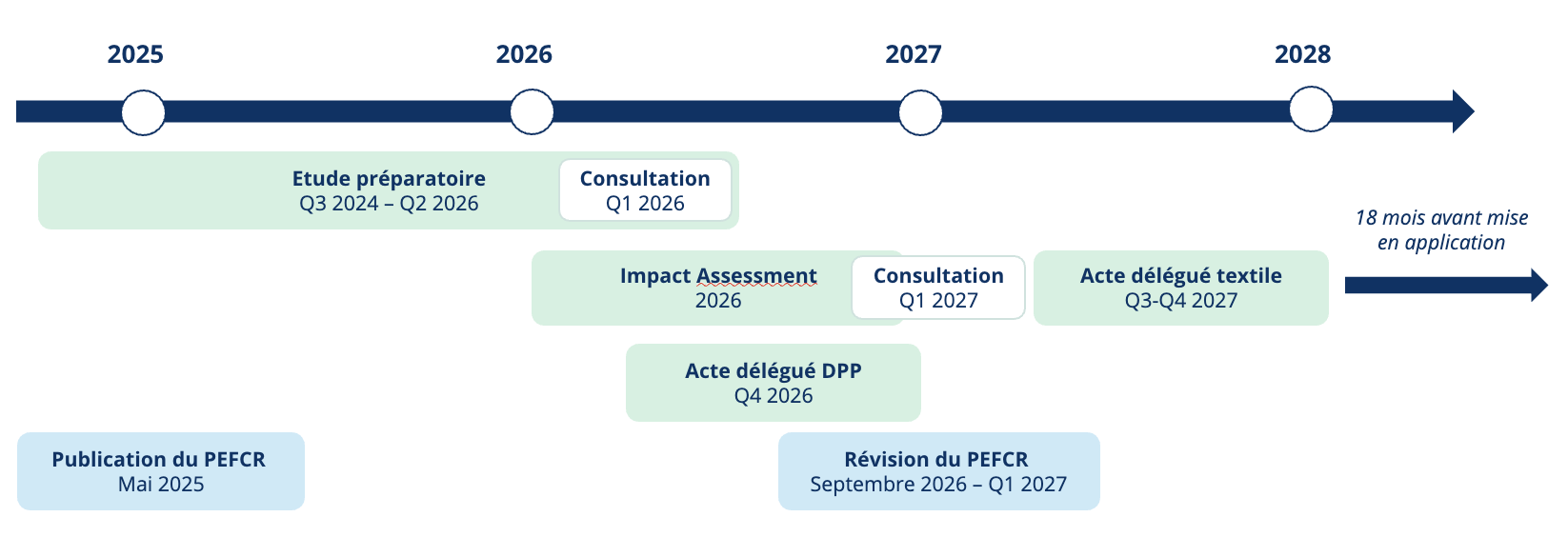
For a long time, the ESPR and the Digital Product Passport were viewed as topics for regulatory monitoring. In 2026, this is no longer the case. We are entering a phase where the regulatory options are clear enough for fashion brands to begin preparing for them. The technical work of the preparatory study is nearing completion, and the regulatory phase can now begin. For brands, the 2028–2029 collections will likely be the first to be affected, which means they need to start preparing now.
The issue is becoming a priority for another reason: the ESPR is not merely intended to improve the information available to consumers. It is a regulation that will ultimately determine market access in Europe for products placed on the market.
Background and Objectives of the ESPR Regulation
The ESPR, or Ecodesign for Sustainable Products Regulation, is the European regulation aimed at making eco-designed products the norm in the European market. Set to take effect in July 2024, its purpose is to establish sector-specific eco-design requirements for products manufactured, imported, or distributed within the European Union. These requirements will be specified on a product-by-product basis through delegated acts. Its objective is simple yet ambitious: to reduce environmental impacts throughout the entire product lifecycle. This includes raw materials, manufacturing, use, and end-of-life.
The ESPR does not immediately establish identical specifications for all products. It creates a framework, and the European Commission then adapts this framework for each product family, based on the impacts, the maturity of the methods, and the ability to verify the requirements.
The textile sector is one of the priority categories, particularly because it accounts for a large volume of goods, relies on complex and globalized supply chains, and has significant impacts across the entire lifecycle—from raw materials and manufacturing to use and end-of-life.
Where exactly are we in the regulatory process?
In April 2025, the European Commission published its first ESPR Working Plan (2025–2030), which confirms that textiles are among the priority categories.
The project is still in the preliminary study phase outlined in the ESPR. The third milestone (out of four) of the preliminary study, released in early 2026, marks the beginning of the end of the technical analysis phase: the scope and regulatory requirements have now been identified, allowing brands to start preparing for them.
What is proposed as the basis for the delegated act
(a) Product scope
The scope of the delegated act on textiles is clearly defined, with clearly specified categories that are included and excluded.
The scope covers textile apparel, in line with the PEFCR Apparel & Footwear categories, excluding footwear. This includes, in particular, T-shirts, shirts, and blouses; sweaters and mid-layers; jackets and coats; pants and shorts; dresses, skirts, and jumpsuits; leggings, tights, and socks; underwear; swimwear; and textile clothing accessories.
The following are excluded from the scope: footwear, home textiles, technical textiles, upholstery textiles, non-textile products, workwear or PPE, textile healthcare products, and composite products in which textiles do not constitute the predominant component.
(b) Design options for the future delegated act on textiles
The technical framework is also already in place: four design options are considered technically feasible, legally sound, and cost-effective.
These design options can combine information requirements with performance requirements. They are structured around four general objectives:
Mitigate one-time environmental impacts (raw materials, manufacturing, end-of-life) by extending the product’s useful life.
Increase the availability of secondary materials.
Reduce the environmental impacts associated with raw materials.
Reduce the environmental impacts of manufacturing.
These objectives are translated into four main design options:
DO1: Information on robustness
DO2: Information on recyclability
DO3: Information and Performance Requirements for Recycled Content
DO4: Information on the environmental or carbon footprint of manufacturing
Certain options initially considered (repairability, sustainability of fiber production, pollution from textile fragmentation) were analyzed but not selected at this stage due to clearly identified methodological or regulatory limitations.
Design Option 1: Robustness
The goal of this design approach is to extend the useful life of products in order to mitigate the environmental impacts associated with raw materials and manufacturing, which account for 81–90% of total impacts.
Disclosure requirement: A robustness score between 0 and 10 must be provided
Performance requirements: No mandatory performance requirements are proposed at this stage
Durability is a good example of the ESPR approach. The JRC acknowledges that eco-design does not account for the entire actual lifespan of a garment, as a significant portion of discards depends on factors such as fashion trends, fit, or perceived value. However, it believes that structured information on durability can guide consumers and encourage manufacturers to improve their products.
Robustness score for woven products
Robustness score for knitted products
Design Option 2: Recyclability
The goal of this design option is to increase the proportion of textiles that are actually recycled and to support the availability of secondary materials.
Disclosure requirement: A recyclability score between 0 and 10 must be provided.
Performance requirement: No mandatory performance requirements (banning non-recyclable products was deemed disproportionate).
This approach is very practical for product teams. It requires a close examination of the product’s composition, assembly, accessories, finishes, and anything else that hinders the recycling process. This approach may resemble, in part, the criteria already used in Refashion’s eco-modulations. The challenge here is not just to calculate a score. It is to integrate recyclability criteria right from the design phase, where balancing style, functionality, cost, and circularity can sometimes be difficult.
Recyclability score
Design Option 3: Repurposed Content
The goal of this design option is to reduce the environmental impact associated with raw materials by increasing the use of recycled fibers.
Disclosure requirement: Obligation to disclose the mass fraction of recycled content in the product, and, where applicable, the nature of the waste stream (post-consumer vs. post-industrial).
Performance requirement: Option to establish mandatory minimum thresholds for recycled content.
The thresholds would be:
classified by product type,
depending on the type of fiber,
in line with the availability of secondary materials.
Design Option 4: Impact of Manufacturing
The goal of this design approach is to reduce the environmental impacts associated with the manufacturing phase of textile products.
The manufacturing phase is the second-largest contributor to environmental impacts across the entire life cycle of clothing, after raw material production, accounting for more than 20% of the total for most of the product categories analyzed.
The production of raw materials is excluded from the scope of this option because:
The associated environmental impacts depend heavily on the type of fiber,
The calculation methods and available data are not sufficiently standardized to allow for reliable comparisons between fibers.
Disclosure requirement:
Voluntary disclosure, limited to products with above-average performance.
Use of the PEFCR Apparel & Footwear guidelines for the calculation.
It has not yet been decided whether to use only the CO2 indicator or all of the indicators.
Performance requirements: No performance requirements are specified due to the lack of reliable benchmarks.
Two types of information requirements were analyzed:
DO4.1 – Information on the environmental footprint of manufacturing
This option involves providing information on the overall environmental footprint of the manufacturing phase, calculated in accordance with the Product Environmental Footprint (PEF) guidelines.
DO4.2 – Information on the carbon footprint of manufacturing
This option involves providing specific information on the carbon footprint (greenhouse gas emissions) of the manufacturing phase.
The overall environmental footprint covers a wide range of impact categories, whereas the carbon footprint focuses solely on climate change. The JRC’s analysis highlights that:
the carbon footprint is easier for consumers to understand,
it is based on data that is generally more readily available and more reliable,
but it does not reflect other relevant environmental impacts (water, toxicity, resources, etc.).
The calculation of the environmental or carbon footprint of manufacturing would be based on:
the PEFCR Apparel and Footwear standards,
a combination of primary data (provided by manufacturers) and secondary data.
Which topics have been analyzed but not selected at this time?
Repairability
The JRC considers that repairability is influenced by factors that are too subjective and that there is not yet an objective framework applicable on a large scale. Therefore, no mandatory requirements are proposed. However, voluntary information on repair services offered by brands is still being considered, possibly via the DPP.
Microfibers
The document explains that no robust approach has been established at this stage for microfibers, due to a lack of a harmonized definition of biodegradability, the absence of standardized measurement methods, and a general lack of data.
Impacts of fibers and substances of concern
The third milestone acknowledges that fiber production accounts for a significant portion of overall impacts, but concludes that it would be simplistic and potentially counterproductive to prioritize certain fibers without a sufficiently robust framework. Regarding substances of concern, the approach to information requirements has been thoroughly examined, but the thresholds and coordination with other regulations have not yet been finalized.
The Latest Developments in the Digital Product Passport
The DPP is often reduced to a QR code. The third milestone highlights that the Digital Product Passport is a key tool for implementing the ESPR, designed to centralize and structure product information throughout the value chain, support various information requirements without overloading physical labeling, and tailor the level of information to different users: consumers, authorities, and value chain stakeholders.
The DPP is the tool that will enable brands to provide evidence to support all their environmental claims, with three main objectives:
Transparency (providing greater transparency to stakeholders)
Compliance (facilitating monitoring, traceability, and auditability)
Circularity (more informed reuse, repair, and recycling)
What will be included in the Product Passport?
It is premature to establish an exhaustive and legally binding list of the DPP’s content, as the European IT architecture, data standards, and governance have not yet been finalized. However, a cross-cutting foundation is already identifiable. Another key point: there will not be a single, identical set of content for all products. The framework is common (ESPR), but the final content will depend on delegated acts by product category.
The Mandatory Common Core
Unique product identifier
Textile product category
Fiber composition (% by weight)
Product construction (knitted/woven/denim)
Country / manufacturing locations
Conditional and specific data
Depending on the requirements:
robustness score
recyclability score
repurposed content
environmental impacts
Sections on substances of concern (still under discussion, particularly alignment with REACH and thresholds)
Repair Information / Related Services
The DPP will therefore be modular and scalable.
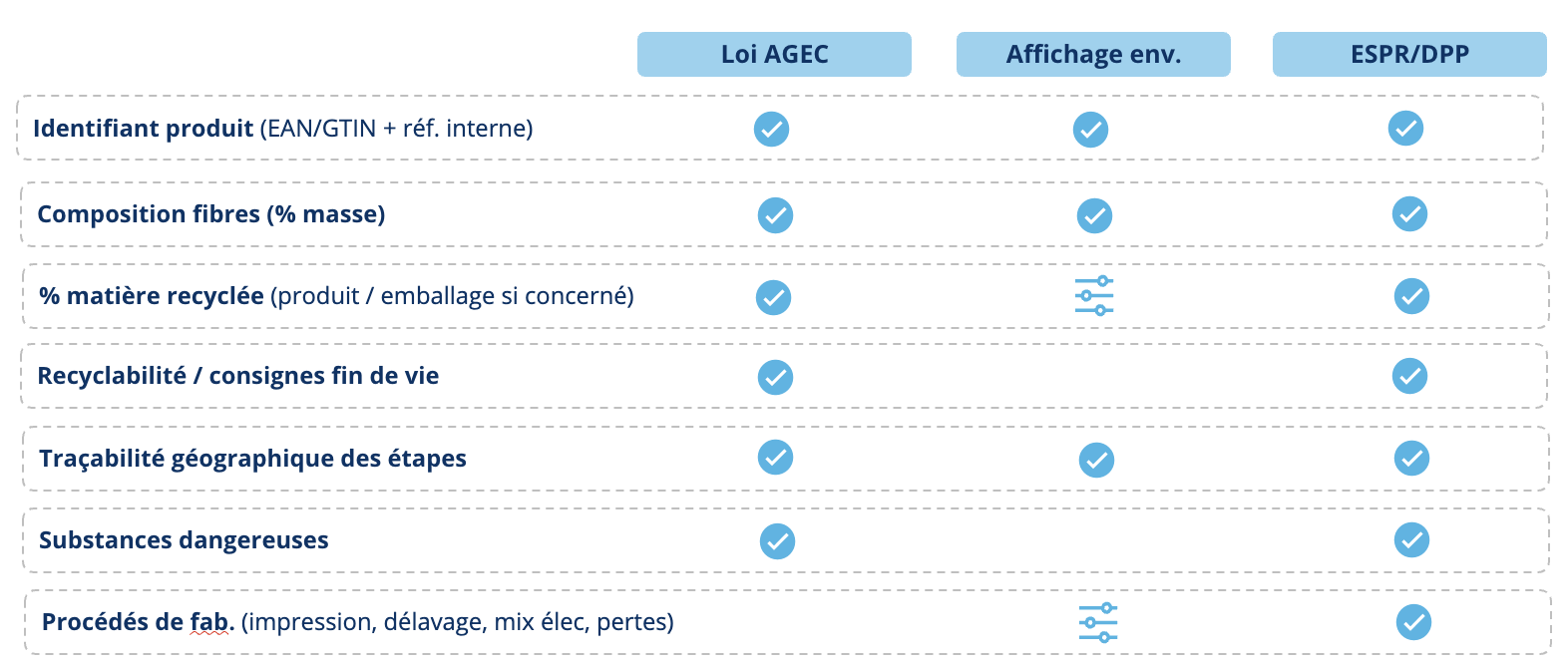
What data is included in the DPP?
What DPP Really Means for Brands
The real issue: the quality of the data produced
The main challenge of the DPP is not to create a QR code or display product information. The real challenge is to build reliable environmental data at the product level across complex supply chains and extensive catalogs.
This data often comes from various systems: PLM, ERP, traceability tools for factories, processes, and certain certifications; supplier data for energy, etc. Many brands already have some of this data, but rarely in a format that can be directly used by a DPP.
A data project, not just a compliance project
This is probably the most important point to remember. The DPP is a project aimed at structuring product data. It addresses data quality, the accuracy of product compositions, supplier documentation, version management, and data consistency across the quality, procurement, CSR, IT, and compliance teams.
A common data foundation can also be reused as a basis for meeting various regulatory requirements: the AGEC Act, environmental labeling, the DPP, GHG Protocol reporting, the CSRD, eco-design, and decarbonization strategies.
For a brand, this changes everything. The DPP should not be viewed as just another regulatory silo. It should become an additional use case for a better-structured product database.
Why plan ahead as early as 2026?
Potential risks
The first risk is regulatory. If companies wait for the final text before taking action, they will have to handle everything simultaneously and within tight deadlines: data collection, tool selection, data quality assurance, product decisions, internal training, and document governance.
The second risk is operational. The elements needed to meet the DPP and ESPR cannot be put in place overnight. Certain production-related decisions are made early in the product lifecycle, which means we need to be able to anticipate them.
The third risk is strategic: the proliferation of different tools, systems, and methods. Without a common data model, a brand may end up with one set of data for the product lifecycle assessment (PLA), a different set for environmental labeling, and yet another set for its eco-design decisions.
The benefits for brands that get a head start
Conversely, taking a proactive approach allows you to balance the workload, gradually improve data quality, and turn compliance into a driver of transformation and performance. This will enable you to streamline data collection processes to better calculate environmental impacts and costs, anticipate future performance requirements, improve the accuracy of your carbon footprint, and turn data into a catalyst for action across your various teams.
Not to be missed
Every month, receive the latest regulatory news and our advice on how to decipher it.
You'll receive the next news soon!
Error, please try again.
Similar articles
Empowering Consumers (ECGT): What's Changing for Environmental Claims in Furniture

.png)




.png)
.png)
.png)


