Environmental data: How can we turn regulatory requirements into a driver of performance?

Benjamin THOMAS
April 30, 2026

.png)

Climate pressure is no longer just a matter of corporate social responsibility. It is becoming a global strategic issue for fashion and apparel brands, and environmental data is key to addressing it.
Collecting data to complete reports. Strengthening traceability to meet regulatory requirements. This is still the reality for many brands today.
However, brands that go the extra mile have understood something fundamental: well-structured environmental data is not a cost—it’s an asset. It provides access to financing, helps win bids, reduces supplier risks, and engages teams that too often operate without a clear understanding of their environmental impact.
This is precisely the topic that WARO and Trace for Good explored during a conference held as part of the Fashion Act trade show: "Turning environmental data into a driver of differentiation and performance." This article summarizes the key takeaways.
Before we talk about impact management or differentiation, let’s take a look at the reality on the ground. What CSR, Procurement, and Product teams experience on a daily basis often looks like this:
This isn’t just a matter of regulatory compliance (ESPR, CSRD, DPP, etc.). It’s a source of real business pressure: supplier risk management, brand reputation, access to financing, and the ability to meet the requirements of major retailers. Brands that haven’t structured their data yet are falling behind on issues that are becoming key criteria for business selection and differentiation.
Brands that have organized their environmental data—including traceability and impact measurement—are seeing tangible results across several areas:
Many brands still treat data as a one-off project. The most advanced ones treat it as a strategic asset. The difference often comes down to the initial decisions.
Mistake #1: Collecting data without knowing what to do with it
Implementing a system "just because it's a good idea," without a clear objective or an explanation of the process to suppliers, drives up costs and increases team burnout. Without a clear objective, the ROI cannot be demonstrated internally, so leadership does not support it.
Mistake #2: Trying to collect everything right from the start
Asking a supplier for energy consumption data when you’ve never discussed these topics with them before is the surest way to never get a response and to burden the supplier with unusable data. A relationship is built gradually. You explain why before you ask what.
Mistake #3: Outsourcing Without Maintaining Control
Entrusting your data to a "black box" that delivers results weeks later, with no transparency regarding the methods used, almost always leads to disappointment: data that is difficult to act on, low internal buy-in, and an inability to track progress over time or reuse the data for other purposes.
The most forward-thinking companies no longer view environmental data as a CSR issue or a one-off deliverable. Instead, they treat it as a core component of their business management infrastructure.
Well-structured data is data that:
Step 1: Audit of the Current Situation
The first question isn’t “What data should we collect?” but “How will this data be integrated into the organization and used by teams?” Identify gaps, assess what can be reused, and prioritize based on the next strategic step (roadmap, DPP, RFP). Don’t start from scratch.
Step 2: Start with the regulations
Regulatory requirements are often the best place to start—they force you to establish a basic database. But brands that stop there remain focused solely on compliance. The challenge is to use this constraint to build a competitive advantage.
Step 3: Take it a step further depending on the goal
Depending on what you want to do with the data, the collection process will vary:
Key takeaway: We recommend starting with basic data (regulatory information, audit results, and primary data essential for impact calculations), building the relationship with the supplier gradually, and only requesting specific data once the supplier understands why it is being requested.
Example — Grain de Malice: Integrating specific data from 19 suppliers doubled the calculable reduction potential, unlocking access to green loans. Read the full case study.
Once the foundation is in place, the focus shifts from data collection to taking action. And that’s where many brands run into real challenges.
Mistake #1: Goals that are too far removed from the realities on the ground
Generic data with insufficient granularity produces results that teams cannot take ownership of or put to use. The impact remains a CSR issue, not an operational lever.
Mistake #2: Reacting Instead of Anticipating
CSR cycles are often out of sync with product development cycles. Product decisions (such as the choice of materials, suppliers, and modes of transport) are made without real-time visibility into their environmental impacts.
Truly effective impact management is the ability to:
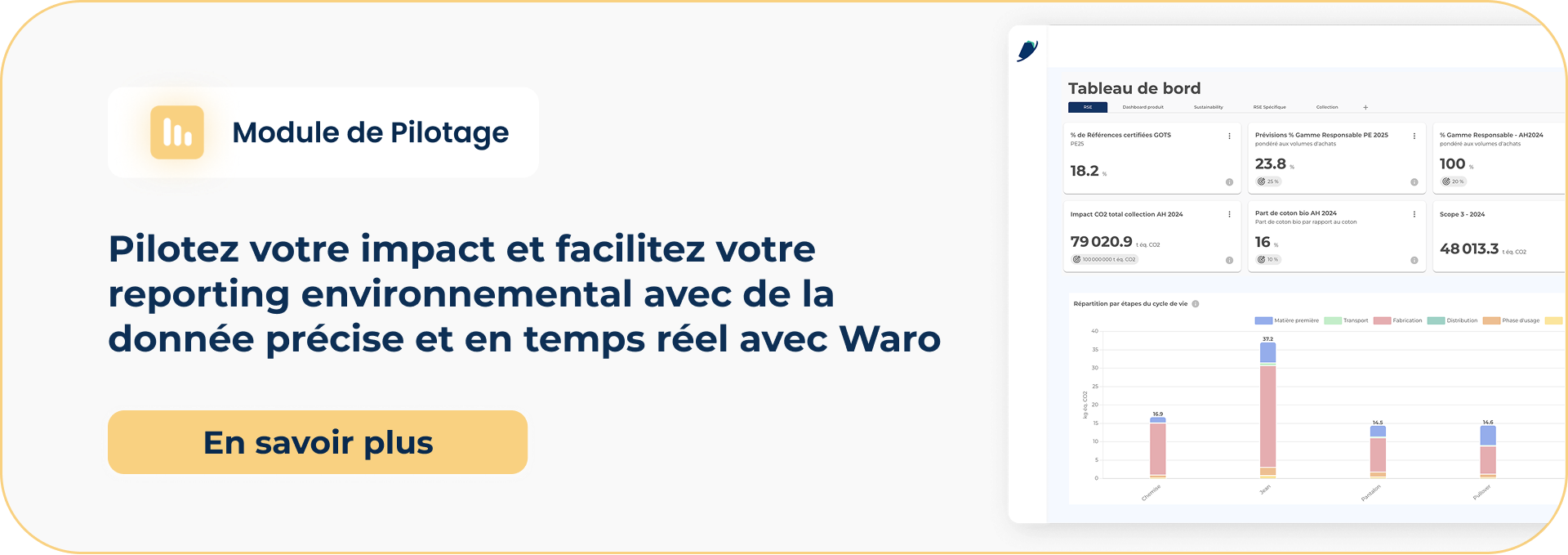
1. Set goals that reflect the reality on the ground
There are two stages of maturity:
Stage 1: CSR-led management. The objectives are set by CSR. This is Level 1: we test different approaches, determine what is feasible (given constraints on margins, budgets, and sourcing), and develop trajectory scenarios. But without team-level implementation and regular check-ins, the approach remains fragile.
Phase 2: Involving the business teams. The Purchasing, Product, and Style teams each have their own KPIs. The CSR strategy is broken down into objectives tailored to each team and integrated into their existing tools and processes.
At Celio, theSBTi framework has enabled the company to transition from a qualitative roadmap (a few organic cotton products and scattered initiatives) to quantitative targets, broken down by phase, department, and year. Buyers are now held accountable for their CSR targets in the same way they are for their margin targets. That is what has driven buy-in.
2. Incorporate eco-design into the product development cycle
There is no one-size-fits-all approach: every brand operates differently. Our recommendation: immerse yourself in the business to understand how teams work, what challenges they face, and what tools they use, before proposing an integration plan.
The three key moments when reviewing environmental data really makes a difference:
3. Ensure effective monitoring and sustainable adoption
.png)
Most brands still approach these issues as a matter of choosing tools. In reality, it’s a matter of choosing a system.
Specifically, this system should enable the following:


.png)
.png)
.png)
