Textile DPP: Everything Fashion Brands Need to Know About the Future Digital Passport
The JRC has just published the key elements of the future textile DPP. Existing requirements, product data, use cases, and level of detail: everything fashion brands need to prepare for now.
The European Commission has just taken a decisive step forward in developing the Digital Product Passport (DPP) for textiles. In mid-May 2026, the JRC (Joint Research Centre), the Commission’s technical research office, published a preparatory report that lays the first concrete foundations for the content of the future digital passport for fashion products. This document is not yet a regulatory text, but it directly informs the delegated act expected in 2027. For brands, it is the first clear indication of what they will need to measure, collect, and publish.
In this article, we break down the most practical aspects of the report: a mapping of existing obligations, details on the expected product data, the 13 identified use cases, the issue of granularity, access rights, and several less obvious but equally significant implications: the mandatory physical medium, data retention periods, the supplier data paradox, and a use case that should serve as a warning to brands with a large number of SKUs.
What the Textile DPP Must Include: An Overview
The JRC report proposes a four-category data structure for the digital passport:
Producer identification: operator and manufacturing site identifiers, contact information
Product information: fiber composition, mechanical properties, substances of concern, recycled content, carbon and environmental footprint, care instructions
Compliance documentation: declarations, certifications, test results
This scope is broader than what many brands currently collect. The good news is that much of this data is already being used to meet other regulatory requirements.
The DPP as a focal point for existing regulations
The report includes a diagram illustrating how the DPP relates to existing European and national regulations.
Textile Labeling Regulations (TLR)
The TLR is the regulation most directly related to the DPP. Fiber composition (names and percentages, e.g., "98% cotton, 2% spandex") is already required on the physical label. It will be included in the DPP, with the added benefit of being digitally accessible throughout the product’s lifecycle.
The ongoing revision of the TLR aims to expand these requirements. The following information is currently under discussion to be made mandatory on the physical label, with additional voluntary information to be included on the digital label hosted in the DPP:
Maintenance instructions: already mandatory in 13 Member States and several third countries (the United States, Canada, Japan, China), but not yet harmonized at the European level
Country of origin (final place of manufacture): already required in Spain and Lithuania for products from third countries, in France for the entire supply chain, as well as in Canada, China, and the United States
Size: already mandatory in Estonia, Slovakia, and China
Composition of non-textile components: leather, fur, rubber, plastics. Several Member States already require this (Belgium, Estonia, France, Italy, Portugal, and Spain for leather and fur)
For brands, the challenge is not to treat the DPP and the TLR revision as two separate projects: the data collected for one will directly inform the other.
REACH: Chemical Substances
The REACH Regulation already requires the disclosure of substances of very high concern (SVHCs) present in concentrations exceeding 0.1% by weight. This existing requirement will be included in the DPP, but the ESPR Regulation plans to go further.
The DPP must include all substances of concern (SoC) as defined by the ESPR, a broader category than just REACH SVHCs. For each identified substance, the passport must specify:
The name or code of the substance (IUPAC nomenclature, EC number, CAS number)
Its location within the product
Its concentration or concentration range (expressed as a weight percentage)
Instructions for safe use, if necessary
Useful information on dismantling, recycling, and end-of-life management
The report notes that this is one of the least mature areas of data in the industry: current chemical certifications, such as OEKO-TEX Standard 100, operate on a binary model (compliant/non-compliant) and do not generate structured data on concentrations or locations. The transition to a system of explicit disclosure represents a significant effort for brands and their suppliers.
Consumer Rights Directive (revised by the Empowering Consumers Directive)
For all consumer goods, including textiles, two new requirements have been in effect since the revised directive took effect:
Statutory warranty of conformity: Sellers must inform customers of the existence and key terms of the 2-year statutory warranty through a standardized notice. This information must be included in the product information sheet.
Commercial durability warranty: If a brand offers a commercial warranty that exceeds the mandatory two-year legal warranty, it is required to display this information using a standardized label—and to report it in the DPP. This serves both as a transparency requirement and, for brands that emphasize sustainability, as a means of differentiation.
CSRD
The Corporate Sustainability Reporting Directive ( CSRD ) requires large companies to prepare sustainability reports structured in accordance with the European Sustainability Reporting Standards (ESRS). Two indicators are relevant to the DPP:
Scope 1, 2, and 3 GHG Emissions (ESRS E1-6): mandatory for companies that have identified climate change as a material issue. The timeline varies by company size: companies with more than 750 employees must include Scope 3 emissions starting in the first year of reporting; for smaller companies, a deferral is permitted.
Total weight of products and materials used, including the proportion of secondary (recycled) content (ESRS E5-4): required if incoming resource flows are assessed as material.
Important limitation: These CSRD indicators are defined at the company level, not at the product level. Therefore, they cannot be directly incorporated into the DPP without a breakdown by model. However, brands that have implemented CSRD reporting already have a data collection infrastructure in place that will facilitate the transition to product-by-product calculations.
EU Ecolabel (voluntary)
The EU Ecolabel is a recognized voluntary certification scheme. For the textile sector, it imposes strict criteria on fiber sourcing, manufacturing energy efficiency, hazardous substances (via a defined RSL list), and "fitness for use" metrics (dimensional stability, colorfastness). If a brand holds this label for a given product, it must indicate this in the DPP. It is one of the few environmental performance indicators publicly available in the DPP.
French regulations: the AGEC Act and Eco-score
France is ahead of the curve on several requirements that directly foreshadow what the DPP will mandate at the European level.
The Eco-score assigns an environmental score based on specific product characteristics (weight, fiber composition, etc.). It incorporates 16 environmental indicators as well as a sustainability coefficient. As of October 2025, displaying the score is voluntary, but it becomes mandatory whenever an environmental claim is made. Starting in October 2026, third parties will be authorized to calculate and publish these scores for brands that do not do so themselves. The JRC report explicitly cites this national precedent as relevant to the development of the European DPP.
Key takeaway: French brands that have already set up their data collection systems for the Eco-score and the AGEC law are a step ahead when it comes to the DPP. The data on composition, weight, and environmental indicators used for the Eco-score largely matches what is required for the European Digital Passport.
Product data required in the DPP: details
This is the core of the report. It provides an inventory of product data to be included in the DPP, along with the reference methodology, data type, and an assessment of the current level of maturity in the industry for each item.
Material Information
Fiber composition: This is the most established data point: already required under the TLR, it is collected and reported by all stakeholders. The DPP will make this information available digitally throughout the product’s entire lifecycle, including for secondhand clothing that no longer has a physical label.
Component specifications: Buttons, zippers, rivets, straps: The report proposes identifying each component with a GTIN. This data point is classified as optional in the current proposal.
The reason: user behavior analysis did not identify the lack of information as a major barrier to repair. The report recommends not making this a required field, so as not to impose a disproportionate burden on manufacturers.
Mechanical properties
Robustness score: This data point is based on a methodology to be defined in the delegated act, using three tests already widely used internally by manufacturers:
Visual inspection (ISO 15487): colorfastness after washing
Twist (ISO 16322-3, expressed as a percentage): the garment's tendency to twist after washing
Dimensional change (ISO 3759, expressed as a percentage): shrinkage or expansion after washing
These tests are already conducted as part of internal quality control, typically at the batch level. What is new is their structured reporting in the DPP. The report notes that while regulations require a fixed set of tests for all categories of clothing, the number of required tests will increase for certain product lines that are not currently subject to them.
Chemical properties: Substances of concern
This is the most demanding data point in terms of traceability. The DPP must report the following for each substance of concern identified:
Its name or code (IUPAC, EC, CAS)
Its location within the product (e.g., dye on the outer layer, water-repellent treatment on the technical fabric)
Its concentration or concentration range (in % w/w)
Instructions for safe use, if necessary
Useful information for end-of-life: disassembly, recycling, and waste management
Brands currently have limited data maturity in this area. Brands’ chemical management practices rely on supplier declarations, contractual clauses, and third-party certifications (OEKO-TEX Standard 100).
Recyclability
Recyclability score: Methodology to be defined in the delegated act, based on composition data already available within the industry. The score is determined by the garment’s composition; therefore, it does not vary within a single model, and the model-level granularity is sufficient.
The current maturity of this data is fairly low, but its complexity is assessed as low because the underlying data (fiber composition) is already being collected.
Repurposed content
Percentage of recycled content: expressed as a weight-to-weight percentage. Methodology based on ISO 14021:2016, to be specified in the delegated act. This data point is also relevant for verifying any minimum threshold for recycled content that might be introduced as a performance requirement.
Source of recycled content: The report distinguishes between pre-industrial waste (production scraps), pre-consumer waste, and post-consumer waste, with a possible further distinction between materials derived from textile waste or other sources, and between EU and non-EU production.
Brands have limited data on this topic: even those that report their recycled content rates generally do not specify the source of that content. Certifications such as the Global Recycled Standard (GRS) technically allow for this distinction, but this information is not consistently provided.
Note: The definitions used in ISO 14021:2016 do not align perfectly with those in the ESPR. What ISO refers to as "post-consumer" corresponds to the sum of "pre-consumer + post-consumer" in ESPR terminology. Brands using GRS or RCS certifications must verify that the definitions match before reporting this data in the DPP.
Organic content and the EU Ecolabel
Organic content: expressed as a percentage by weight, in accordance with the European Regulation on organic farming (EU) 2018/848. This data point is classified as voluntary in the current proposal: it allows consumers to choose clothing made from organically produced fibers, but this does not necessarily constitute a more sustainable choice over the entire life cycle. Definitions of “organic” vary across certifications (GOTS, OCS), which introduces the risk of differing interpretations.
EU Ecolabel: Few brands in the apparel sector have their products certified under this label. It remains relatively uncommon, largely due to its cost and the complexity of its criteria.
Product environmental footprint
This is the least developed data point in the entire proposal, and one of the most critical for ensuring comparability across brands.
Product carbon footprint: calculated according to the PEFCR Apparel & Footwear standard, under the climate change impact category, with partial consideration of life cycle stages to be specified in the delegated act. Expressed in kg CO₂e/kg of product.
Product environmental footprint: a single multi-impact score based on the PEFCR, expressed in environmental points per kilogram.
The two indicators will be reported in two ways: as absolute values (for traceability and verification) and as performance categories relative to an industry benchmark (to enable consumer comparison).
The report notes that stakeholders consider lot-level calculations to be disproportionate: the model granularity is used as the baseline, with the option to use default values, averages, or worst-case scenarios to fill in gaps in supplier data.
Instructions and warranties
Maintenance instructions (methodology: TLR and ISO 21600:2019) Already standard practice and mandatory under several national laws, although not harmonized at the European level. The DPP will ensure long-term access to this information, even after the physical label is lost, which will also be relevant for the second-hand market.
Repair instructions: listed as optional in the proposal. The behavioral analysis cited in the report does not identify a lack of information as a major barrier to repair. The main barriers are the cost of repair and fashion trends. The report recommends not making this a required field to avoid an undue burden without a demonstrated benefit.
Contact information for the brand’s repair services: voluntary; applicable only if the brand offers its own repair services. The report considers it inappropriate to require brands to list local independent repair shops.
Duration of the commercial warranty: If the brand offers a commercial warranty that exceeds the statutory two-year period, it must indicate this in the Product Information Sheet (PIS). Reference: ISO 22059:2020 and the revised Consumer Rights Directive.
The 13 use cases for the DPP: Who uses the passport for what?
The report identifies 13 distinct use cases, organized around four main groups of stakeholders. This overview is essential for understanding why certain data is requested and for anticipating how the DPP will actually be used by third parties.
Public authorities: oversight and supervision
Automatic completeness check: Beforea DPP is finalized and registered in the EU registry, an automated validation system checks that all mandatory fields defined in the delegated act are present and correctly formatted. This check focuses on form (presence and format of data), not on substance (accuracy of values). Required data: all mandatory fields of the DPP.
Customs checks for imported products: Uponentry into the EU, customs authorities may consult the DPP register using product identifiers or the physical data carrier to verify that a passport has been registered, in accordance with Article 15 of the ESPR. If a passport is missing or contains inconsistencies, the products may be detained. Required data: product identifier, identity of the manufacturer and importer, origin, fiber composition, customs codes, weight, and packaging.
Continuous market surveillance by national authorities (MSAs)Market surveillance authorities use the EU DPP portal to access product data, verify certifications, assess compliance with ESPR requirements, and identify non-compliant products. The DPP supports both proactive surveillance (based on risk profiles) and reactive surveillance (following a report). MSAs will be able to annotate the DPP with the results of their inspections. Required data: all mandatory data, test results, and compliance documentation.
Statistical Monitoring of Imports and Production: Market authorities require aggregated data on import volumes, geographic origins, material compositions, and environmental indicators to fulfill their statistical reporting obligations. The DPP registry provides this data in a structured format, reducing the current administrative burden. Required data: product category, origin, operator identity, fiber composition, weight, recycled content, environmental footprint.
Detecting fast fashion patternsThis isthe use case that poses the most immediate regulatory risk for certain brands. Statistical authorities and the European Commission will be able to use the DPP registry to detect ultra-fast fashion practices through two mechanisms:
The number of new models registered by operator over a given period. A high volume of new models registered indicates an accelerated refresh of collections
Cross-referencing the date of manufacture with the date of recycling drop-off: once a garment is dropped off at the end of its life, it is possible to determine its actual lifespan and link it to its original manufacturer
These metrics could influence adjustments to EPR contributions. Brands with a broad product range and rapid product turnover are directly exposed to this new regulatory financial risk.
Verification of Sustainability in Public Procurement: Publicbuyers will be able to review the DPPs submitted in response to calls for bids to verify compliance with Green Public Procurement (GPP) criteria. The DPP provides standardized and verifiable data on environmental performance, material composition, and sustainability attributes, supporting transparent and evidence-based purchasing decisions.
Consumers: Information and Care
More Sustainable Shopping: In-store, customers can scan a garment’s label to access information on sustainability, recycled content, recyclability, and environmental impact.
Proper garment care: Whenthe physical care label is lost or illegible, the DPP allows you to access care instructions via the data medium. This is also useful for secondhand purchases, where the label is often missing. Required data: care instructions.
DIY Repairs: Forconsumers who wish to repair damaged clothing themselves, the DPP could provide repair instructions and specifications for replacement parts (buttons, zippers). This use case is classified as a low priority in the report: the behavioral analysis does not identify a lack of information as a major barrier to repair.
Find repair services: The DPP may list repair services offered directly by the manufacturer.
B2B: Second-hand market and professional repair services
Resale in the secondhand market: Secondhandretailers can access DPP data to verify a product’s authenticity, composition, and characteristics before listing it for sale. This information builds buyer confidence and supports the growth of the secondhand market. Required data: product identifier, composition, durability score, recyclability, recycled content, substances of concern, environmental footprint.
Facilitating Professional Repairs: Repair service providers can consult component specifications in the DPP to source identical replacement parts (buttons, fasteners), which are essential for maintaining the garment’s aesthetic integrity.
End of life: sorting and recycling
Sorting for Recycling and Reuse: End-of-life sorting operators currently lack reliable information on the composition, hazardous substances, and non-recyclable fibers of materials, which hinders the efficiency of the sorting process and the quality of the secondary materials produced.
The DPP can address this issue, but only under two conditions: that the composition data is accurate and verifiable (operators cannot afford to sort based on inaccurate data), and that the physical data carrier is still present and readable on the garment at the end of its life. This is precisely why technologies like RFID and NFC are being actively explored: they can withstand wear and tear better than a printed QR code. Required data: fiber composition, material purity, substances of concern.
Environmental data: carbon footprint, eco-score, and benchmarks
This is likely the most fundamental aspect for product and CSR teams at fashion brands. The report proposes two environmental performance indicators for the textile PEF, both based on the PEFCR Apparel & Footwear (Product Environmental Footprint Category Rules):
The report stipulates that these indicators be reported both as absolute values (kg CO₂e/kg for carbon, environmental points/kg for the PEF) and as performance categories. In otherwords, a comparison against an industry benchmark.
This dual display allows for both comparability between products (the class) and traceability back to the calculation (the absolute value). For brands, this means that a product LCA is no longer just an internal tool; it becomes public and comparable data.
Note: The report acknowledges that industry stakeholders consider lot-level calculations to be disproportionate. The model granularity is used as the baseline for these indicators, with average values or worst-case scenarios employed to fill data gaps.
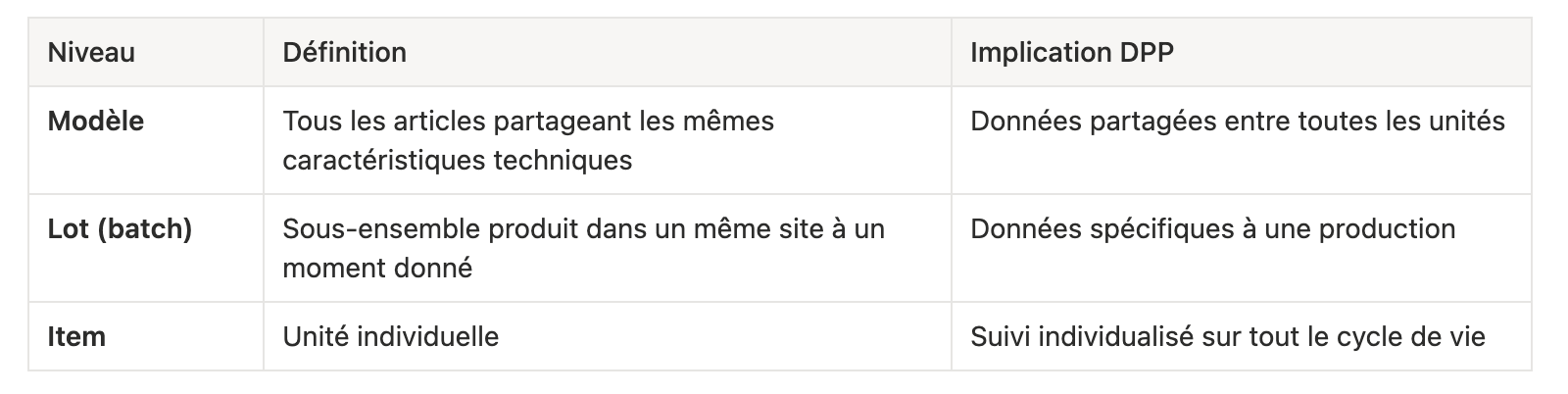
Level of detail in the DPP: model, batch, or item
Granularity is one of the most frequently discussed topics in consultations with industry representatives. The report identifies three levels, each with very different implications in terms of cost and feasibility.
The three levels defined by the ESPR
The recommendation of the JRC report
The report proposes a layered approach:
Template for most product information (fiber composition, durability rating, recyclability, carbon footprint)
Data set for variable data (manufacturing site, chemicals, verified recycled content, importer’s identity)
This is a voluntary measure, designed to allow pioneering brands to invest in this infrastructure now, rather than waiting for it to become mandatory
The paradox of supplier data: the obligation applies to the brand, but the data belongs to the upstream supplier
This is one of the most significant challenges of the system, explicitly mentioned in the report. The obligation to create and maintain the DPP rests with the brand (or the importer if the manufacturer is outside the EU). However, much of the required data (recycled content, chemical substances, carbon footprint) is generated much earlier in the supply chain, by suppliers who have no direct obligation to provide it in a structured format.
On average, more than 15 stakeholders are involved in the production of a single garment. Under current practices, each stakeholder typically has access to information from their immediate supplier, but traceability is often lost as early as Tier 2. Furthermore, 80% of the garments in circulation in the EU are imported, which further complicates cross-border data collection.
An important governance issue for importers: the report specifies that, in the event of inaccurate data, liability is shared between the importer (who was required to exercise due diligence) and the original manufacturer (who provided incorrect information). This dual liability framework should encourage both parties to implement robust data-sharing and traceability procedures.
Access rights: Who can see what in the DPP?
The report proposes three distinct levels of access, based on the sensitivity of the data and the user's role.
The Three-Level Logic
Public access (any user, no authentication required):
Name and address of the operator (manufacturer, importer)
Care Instructions, Warranty Period
Access for authorized authorities only (customs, MSA, European Commission):
Compliance Documentation and Certifications
Declarations of Conformity
Contact information for the responsible operator
Access based on legitimate interest (recyclers, end-of-life operators, etc.):
Location of substances of concern in the product
Environmental Footprint Calculation Parameters
Detailed weight and amount of recycled material
What this means for brands
The most commercially sensitive data (such as specific chemical formulations or LCA calculation parameters) will not be publicly accessible. However, it must be available and verifiable to regulatory authorities. This distinction is essential: preparing the DPP does not mean making all data public, but rather organizing it in such a way that it can be provided according to the required level of access.
Two operational constraints that are often underestimated
Physical data storage: a product design decision
The DPP will not be merely a digital file. It must be accessible via a physical medium attached to the product, its packaging, or its documentation. The report does not prescribe any specific technology, but explicitly mentions QR codes, UHF, RFID, and NFC as compatible options.
There are two operational requirements. First, the label must remain legible for the entire duration that the DPP is accessible. Second, the delegated act will specify where the label must be placed—on the product itself, the label, the packaging, or the documentation. For brands, this means anticipating these requirements from the very start of collection design and production labeling processes.
Retention requirement: at least 10 years after the product is placed on the market
The report is clear: the DPP must remain accessible for at least 10 years after the product has been placed on the market, unless otherwise specified in the delegated act.
For a brand that launches several hundred models a year, this represents a volume of data that must be kept active, traceable, and accessible for a decade. The implications for digital infrastructure, archiving policies, and service continuity are significant and must be addressed well before 2027.
What brands need to anticipate right now
The JRC report is not yet a delegated act; a public consultation and an impact assessment are planned prior to its adoption, which is expected in 2027. However, the data identified as necessary for the DPP is stable enough to begin work on the projects today.
Five concrete priorities:
Mapping available data: What information is already being collected, at what level of detail, and in which systems (ERP, PLM, supplier databases)?
Structuring supplier data collection: traceability beyond Tier 1 is explicitly identified as the main sticking point. Brands that invest in standardized data collection processes today will gain a decisive advantage.
Launching the first product LCAs: carbon and environmental footprints at the model level are the least mature data points in the industry.
Plan for physical support: incorporate digital labeling requirements (QR codes, RFID, NFC) into design and production processes starting with the next collections.
Laying the groundwork for data architecture: 10-year data retention and data portability require technical decisions to be made now, before the choice of a DPP provider is dictated by regulatory urgency.
Would you like to assess your readiness for DPP requirements? Request a demo of Waro to identify which data you already have and which data still needs to be organized.
Not to be missed
Every month, receive the latest regulatory news and our advice on how to decipher it.

.png)

.png)
.png)
.png)


