What kind of wool should you choose to reduce the carbon footprint of your products?
Manon Emieux
August 25, 2026

.png)
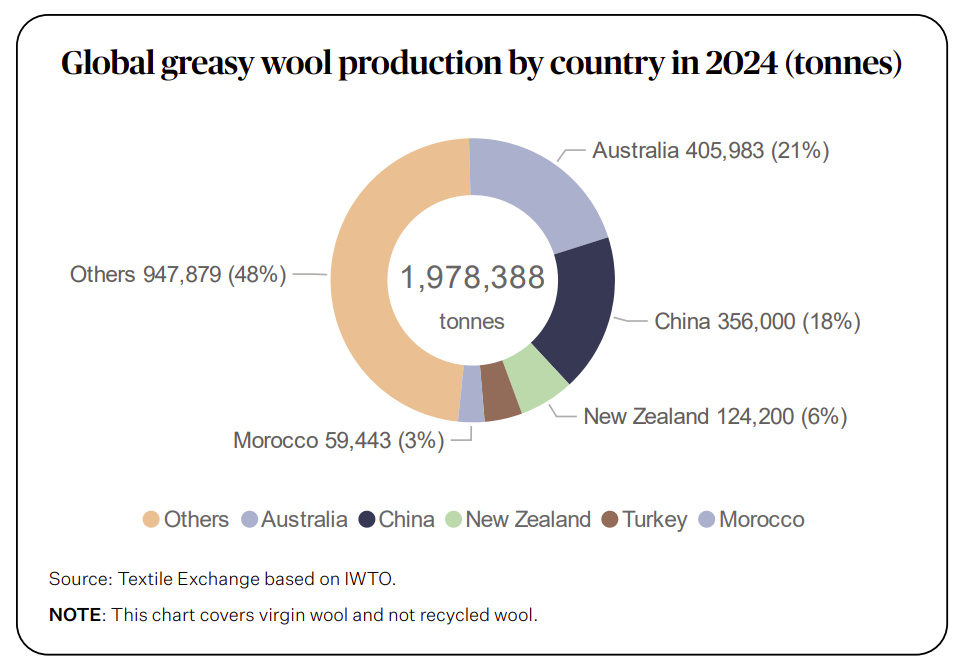
Wool accounts for approximately 2 million metric tons of the 132 million metric tons of textile fibers produced worldwide in 2024, or about 0.9% of the global fiber market (Textile Exchange, Materials Market Report 2025). The top three producers are Australia, China, and New Zealand. Most of the wool used today in Europe for clothing is produced outside of Europe.
Wool is a natural, biodegradable, and renewable fiber, yet it is one of the textile fibers with the greatest environmental impact:
Sheep farming is a significant source of methane emissions—a greenhouse gas 28 times more potent than CO₂ over a 100-year period. Added to this are emissions from animal feed, land management, and chemical treatments (antiparasitic baths, dyes). As a result, over a cradle-to-gate life cycle (from farming to the farm gate), conventional wool has a higher carbon footprint than virgin synthetic fibers.
However, this observation applies only to the climate change indicator. The environmental cost calculated by the official French textile environmental labeling tool—developed by ADEME and the Ministry of Ecological Transition—aggregates 16 impact categories derived from the European PEF/EF 3.1 method, including the physical durability of the garment and the release of microfibers during washing.
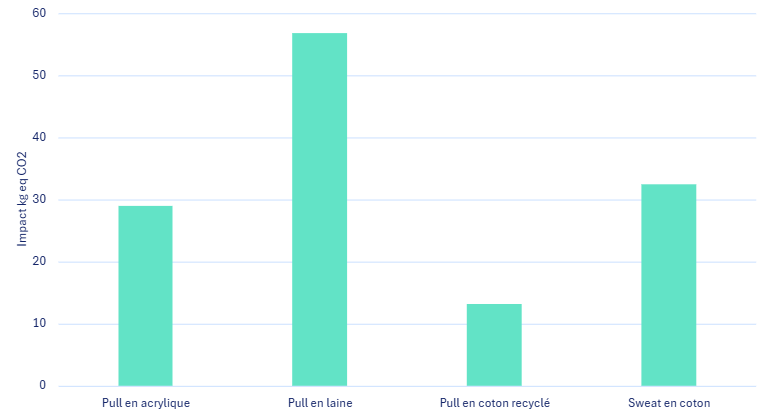
Yet the lifespan of a garment is precisely the factor that has the greatest impact on its actual environmental footprint. A study funded by Woolmark shows that a wool sweater discarded after just one season (15 wears) has an environmental impact 5.8 to 6.8 times greater than the same sweater worn for its entire lifespan (109 wears), and that extending its use to 400 wears reduces the impact by 49 to 68 percent. Wool, which is less prone to pilling and losing its shape than acrylic, is structurally more likely to reach this high number of wears. If kept for a long enough time, a wool sweater ultimately has a lower carbon footprint than two acrylic sweaters (56.7 kg CO₂e for a wool sweater versus 58 kg CO₂e for two acrylic sweaters, ADEME/Impact CO₂), so the material’s durability is a key factor in reducing the environmental impact in its own right.
Conventional wool refers to wool produced on large-scale industrial or semi-industrial farms, primarily in Australia, New Zealand, China, and South America. It meets criteria for volume, consistency, and fineness (microns), but there are no specific requirements regarding farming practices or carbon footprint.
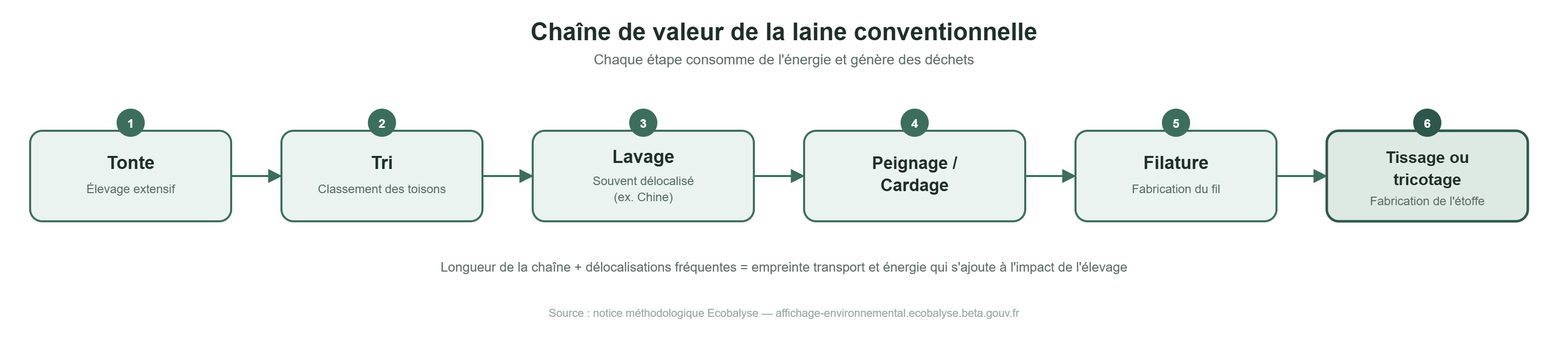
In the Environmental Cost Method model, conventional wool represents Australian extensive sheep farming, which is 75% Merino. The scope of the calculation is from cradle to farm gate (from the animal’s birth to when it leaves the farm).
Wool from this new sector is a category identified by the Environmental Cost Method because it is produced in France, where sheep farming is now focused almost exclusively on meat and milk production. Wool is a byproduct that is practically no longer valued commercially: it sells for a few dozen centimes per kilo, a price that does not even cover the cost of shearing, which is approximately €1.50 per sheep (source: Ecobalyse documentation). This situation stems in particular from the deindustrialization of the French wool sector since the 1980s. Several initiatives provide concrete examples of this category by establishing local networks for collection, sorting, and processing (Laines Paysannes and Collectif Tricolore).
Although livestock production is comparable, in an LCA, this changes everything: the distribution of impacts among products (meat, milk, and wool) is determined by an allocation rule, which specifies what share of the impacts of livestock production is attributed to each co-product. The Environmental Cost method uses an economic allocation (proportional to the sales value of each co-product) and, based on the same reference inventory (Woolmark database), a rate of 37% for conventional wool versus only 4% for wool from the new supply chain (a factor of 9, which directly reflects the difference in commercial value between the two markets).
In practical terms: if a shepherd raises sheep to sell lamb and shears them because it is necessary (for the animals’ well-being), the wool obtained has a minimal impact given the primary purpose of the flock.
Recycled wool is produced from used clothing, garment scraps, or textile waste. In LCA methods, the recovered material is considered to enter the cycle at the beginning without “carrying” the impacts of its previous life with it (the principle of cutting off the system at the collection point).
Only the environmental impacts of the recycling process itself (sorting, mechanical shredding, fiber separation, energy consumption) are accounted for—which are infinitely lower than those of raising sheep and shearing. It is estimated that using recycled wool instead of virgin wool results in a reduction of approximately 90 to 98 percent in CO₂e emissions per kilogram of fiber, depending on the source (notably the Higg Materials Sustainability Index).
This material is still not widely used in clothing: the loss of fiber length during re-spinning limits its proportion in spinnable blends and its mechanical strength, which makes it more suitable for accessories or home goods than for garments that require high durability.
⚠️ The Environmental Cost Method does not yet include recycled wool in its database
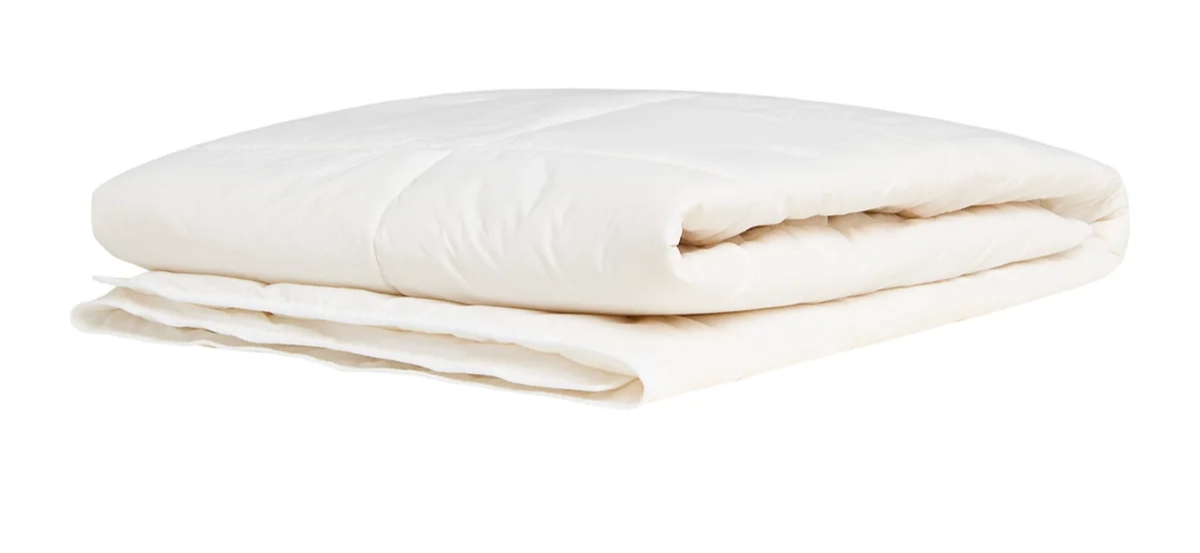
In partnership with Waro, Pyrenex provides a concrete example of the benefits offered by the new wool supply chain through a real product. The Pyrenea summer comforter (Pyrenex × Traille, 100% Pyrenean wool, manufactured in Saint-Sever) achieves a 63% reduction in carbon impact compared to an equivalent conventional wool filling (source: simulation conducted on Waro). The filling comes from wool collected during the annual sanitary shearing of Basque and Béarnais ewes, which previously went unused.
Are you working on the composition of your collections or product lines and want to quantify the benefits of switching materials? Find out how WARO can help you →


.png)
.png)
.png)
